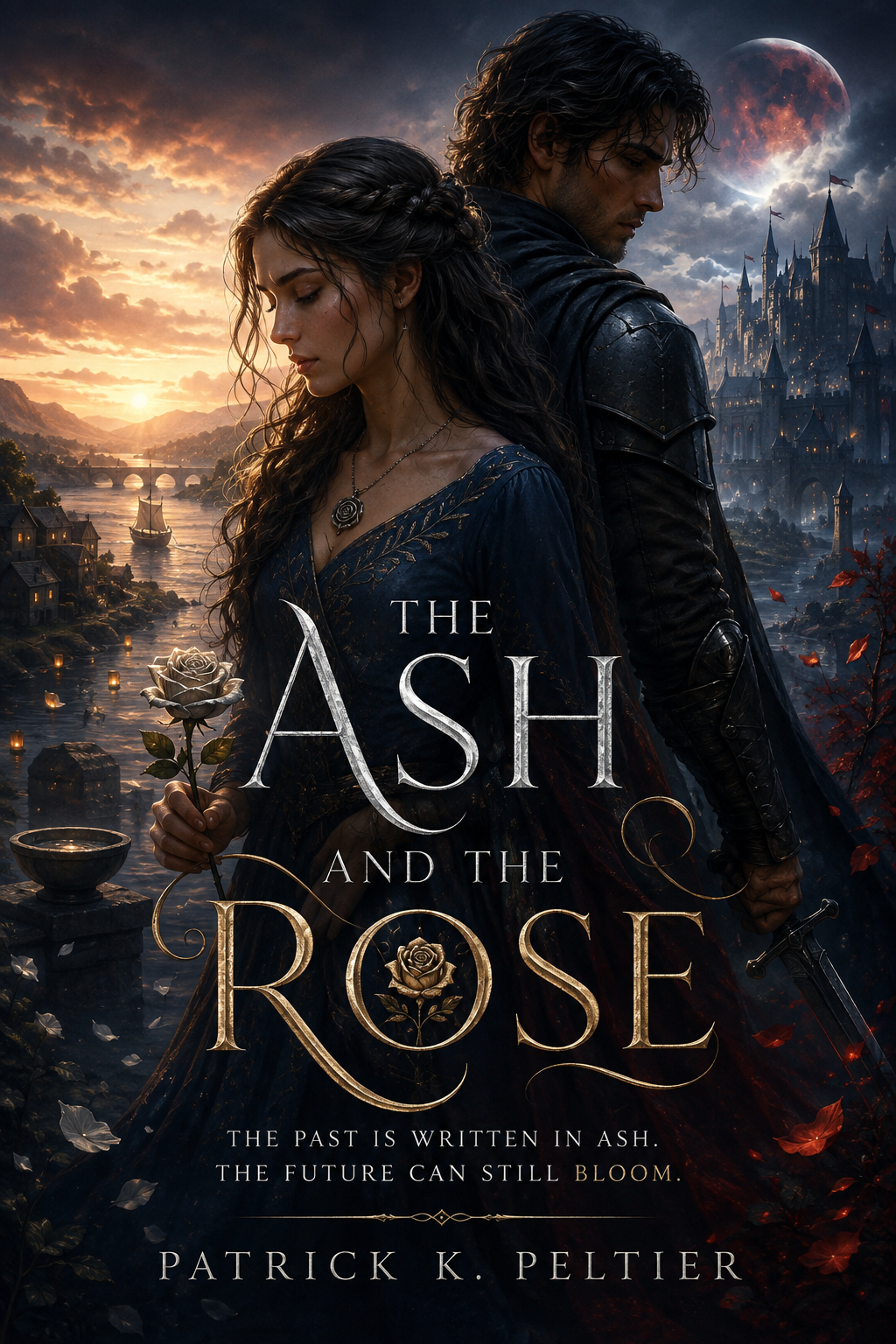
Some truths are buried for a reason.
Others are simply waiting for someone brave enough to remember them.
For five hundred years, the kingdom of Argentia has lived beneath the shadow of a history few still understand.
There is a river beyond the village of Briar Hallow.
Beautiful. Ancient. And feared.
When the Blood Moon rises, no one approaches it.
Soldiers guard its banks.
Doors close early.
Old customs are observed without question.
And when children ask why, they receive the same kind of answers their parents once received:
Some things are better left alone.
Elara has spent most of her life accepting that.
Raised in Briar Hallow by the people she considers family, she has never thought of herself as important. Her world is made from smaller things—familiar faces, shared meals, village traditions, laughter around a table, and the quiet belief that when someone needs help, you help them.
She does not dream of palaces.
She does not seek power.
And she certainly does not expect the history of a kingdom to care who she is.
But history has a way of remembering what people choose to forget.
And the river has not forgotten.
When the Blood Moon returns, everything begins to change.
Kael is a soldier of the Crown.
He understands duty.
He understands orders.
And he understands that protecting a kingdom sometimes means standing between ordinary people and dangers they may never fully comprehend.
He has been taught what deserves protecting.
What should be feared.
And which questions are better left unanswered.
Then he meets Elara.
What begins between them is not instant love.
It isn’t prophecy.
And it isn’t the kind of attraction that makes two people abandon everything they believe the moment they meet.
It begins much more quietly.
With conversation.
Observation.
Small acts of trust.
The gradual realization that the person standing beside you may see the world differently than you do.
And perhaps the more dangerous realization that they may have a reason.
As Kael’s certainty begins to fracture and Elara is drawn toward mysteries that seem somehow connected to her, the two find themselves moving closer to a truth neither of them was searching for.
A truth that reaches beyond one village.
Beyond one king.
And far deeper into Argentia’s past than either understands.
Because kingdoms remember the stories their rulers tell.
But rivers remember everything.
At the heart of Argentia sits a Crown carrying the weight of decisions made long before the present generation was born.
King Alaric believes in law.
In order.
In the responsibility of protecting people from dangers they may not recognize themselves.
He is not a monster sitting comfortably upon a throne.
He is a man trying to protect a kingdom with the history he was given.
But what happens when the history you inherited isn’t the whole truth?
What happens when good people defend terrible decisions because they sincerely believe those decisions prevented something worse?
And what happens when changing course may be every bit as dangerous as continuing forward?
The Ash and the Rose does not divide its world neatly between heroes and villains.
Instead, it asks what happens when people with different loyalties, different wounds, and different pieces of the truth all believe they are doing what must be done.
Because sometimes the most dangerous lies aren’t created by evil people.
Sometimes they are inherited by good ones.
A fantasy built on mystery—not explanations.
Magic exists in Argentia.
But it does not arrive with an instruction manual.
There are old stories.
Half-remembered warnings.
Things beneath the water that should not be there.
Reflections that don’t behave as reflections should.
A sword carrying more history than the man who holds it realizes.
People watching from places where no one appears to be standing.
And a river whose secrets seem to reach across generations.
The answers are there.
But The Ash and the Rose asks readers to discover them alongside its characters.
Some clues matter immediately.
Others may not reveal their meaning until much later.
And some things that appear insignificant…
aren’t.
But this is also a story about home.
For all its mystery, magic, soldiers, palaces and ancient secrets, some of the most important moments in The Ash and the Rose happen around tables.
There is food.
There is teasing.
There are children underfoot.
There are traditions people follow because someone they loved followed them first.
There are friendships that become family and ordinary evenings that only reveal how precious they were after everything changes.
Because a kingdom is not really made from castles.
It is made from people.
And before a reader can fear what might be lost, they should understand why it was worth protecting.
Briar Hallow is not simply where this story begins.
It is home.
And leaving home changes people.
Sometimes returning does too.
And yes… there is romance.
But it has to earn its place.
Elara and Kael do not fall for one another because circumstances force them together.
Their relationship grows through the quieter things.
A question answered honestly.
A confidence kept.
A moment of unexpected vulnerability.
The gradual lowering of defenses.
The discovery that trust can be more intimate than attraction.
There are no shortcuts simply because the story wants two people together.
They have to notice one another first.
Then understand one another.
Then decide whether understanding is enough to risk something more.
Sometimes a hand reaches for another hand before either person has had time to understand why.
And sometimes the most important moments between two people are the ones neither is ready to talk about afterward.
If this sounds like the kind of fantasy you love…
The Ash and the Rose may be for you if you enjoy:
- Slow-burn romance where trust comes before love
- Ancient mysteries revealed piece by piece
- Found family and characters worth becoming attached to
- Kings, soldiers, villages, hidden histories and political tension
- Magic with consequences rather than limitless power
- Moral questions without easy answers
- Small clues that reward attentive readers
- Warmth and humour alongside darker moments
- Characters who change because of the people they encounter
- A fantasy world that grows larger the farther you travel into it
- Cliffhangers that make “one more chapter” a dangerous promise
- Stories that leave something to think about after the adventure ends
And perhaps most importantly…
If you prefer stories where hope is not guaranteed—
but earned.
Beneath everything lies one question.
Every person in Argentia has inherited something.
A belief.
A responsibility.
A fear.
A story about what happened before they were born.
A promise someone else made.
A mistake someone else never corrected.
In that way, perhaps Argentia isn’t so different from us.
We inherit families.
Traditions.
Assumptions.
Old arguments.
Acts of kindness.
Acts of cruelty.
And choices made by people who never imagined we would someday live with their consequences.
We cannot choose all of what reaches us.
But eventually, each generation faces another question.
Not simply:
What did they leave us?
But…
What will we pass on?
Enter Argentia.
Come to Briar Hallow.
Sit at the table while there is still laughter around it.
Walk beside a river you’ve been warned not to approach.
Look carefully at the reflection.
Watch the palace gates.
And when the Blood Moon rises…
remember that every warning began somewhere.
The Ash and the Rose
A romantic fantasy of mystery, memory, trust, sacrifice, and the choices that shape generations.